Every session with the Rutgers Track & Field jump group has left something behind. Not just knowledge, but capability. The six skills outlined below are what I have carried away from that experience — three technical competencies developed through hands-on coaching practice and three personal qualities sharpened by the pressure and responsibility of working in a Division I program.
Hard Skills
Hard Skill #1: Video Analysis & Biomechanical Assessment
One of the most valuable technical skills I have developed through my internship with the Rutgers Track & Field jump group is the ability to record, review, and extract meaningful information from technical video footage. This is not simply a matter of pressing record and watching an athlete jump. It requires knowing what to look for — approach run rhythm, penultimate step mechanics, hip position at takeoff, arm drive, flight phase posture, and landing efficiency and being able to identify deviations from optimal technique quickly and accurately.
In practice, I film jumping sessions from multiple angles, review footage in real time alongside the coaching staff, and use what I see to inform the feedback given to athletes. This skill connects directly to Learned Outcome #1, where my academic grounding in biomechanics gave me the language to interpret what the camera captures. Looking ahead, this skill will be indispensable in my future as a DPT and performance facility owner, video analysis is useful to both clinical rehabilitation and elite athletic development, and I am building that competency now at the collegiate level.
Hard Skill #2: Athletic Performance Testing
Through my work at Rutgers Athletics, I have conducted and assisted in athletic performance testing sessions designed to assess athlete progress and inform programming decisions. This includes operating specialized equipment such as the 1080 Sprint — a robotic resistance-and-assistance training device used to measure and develop sprint mechanics and force-velocity profiles — and speed gates for precise sprint timing across defined distances. Recording results accurately and communicating findings in a way that is immediately useful to coaches and athletes is a core part of this responsibility.
Performance testing is where science meets practice most directly. The numbers we collect — sprint times, jump distances, force output, resistance profiles — are only as valuable as our ability to interpret them and translate them into actionable programming adjustments. I developed an understanding of periodization and data-driven program design. As I move toward a coaching career and eventually my own performance facility, the ability to assess, track, and respond to objective performance data will be one of the cornerstones of the service I provide.
Hard Skill #3: Training Program Design & Periodization
Working inside the Rutgers Track & Field program has given me direct exposure to how a Division I coaching staff structures and manages a full competitive season. I have observed and contributed to the design of weekly training plans across both meet weeks and non-meet weeks — learning how volume, intensity, and recovery are deliberately manipulated to bring athletes to peak performance at the right moment.
This skill connects directly to Learned Outcome #3. What I have learned at Rutgers goes beyond textbook periodization theory. It is the practical understanding of how to read an athlete's readiness, adjust a session on the fly, and make decisions that balance short-term performance with long-term athlete health. This is a skill I will carry into every coaching and clinical role I hold going forward.
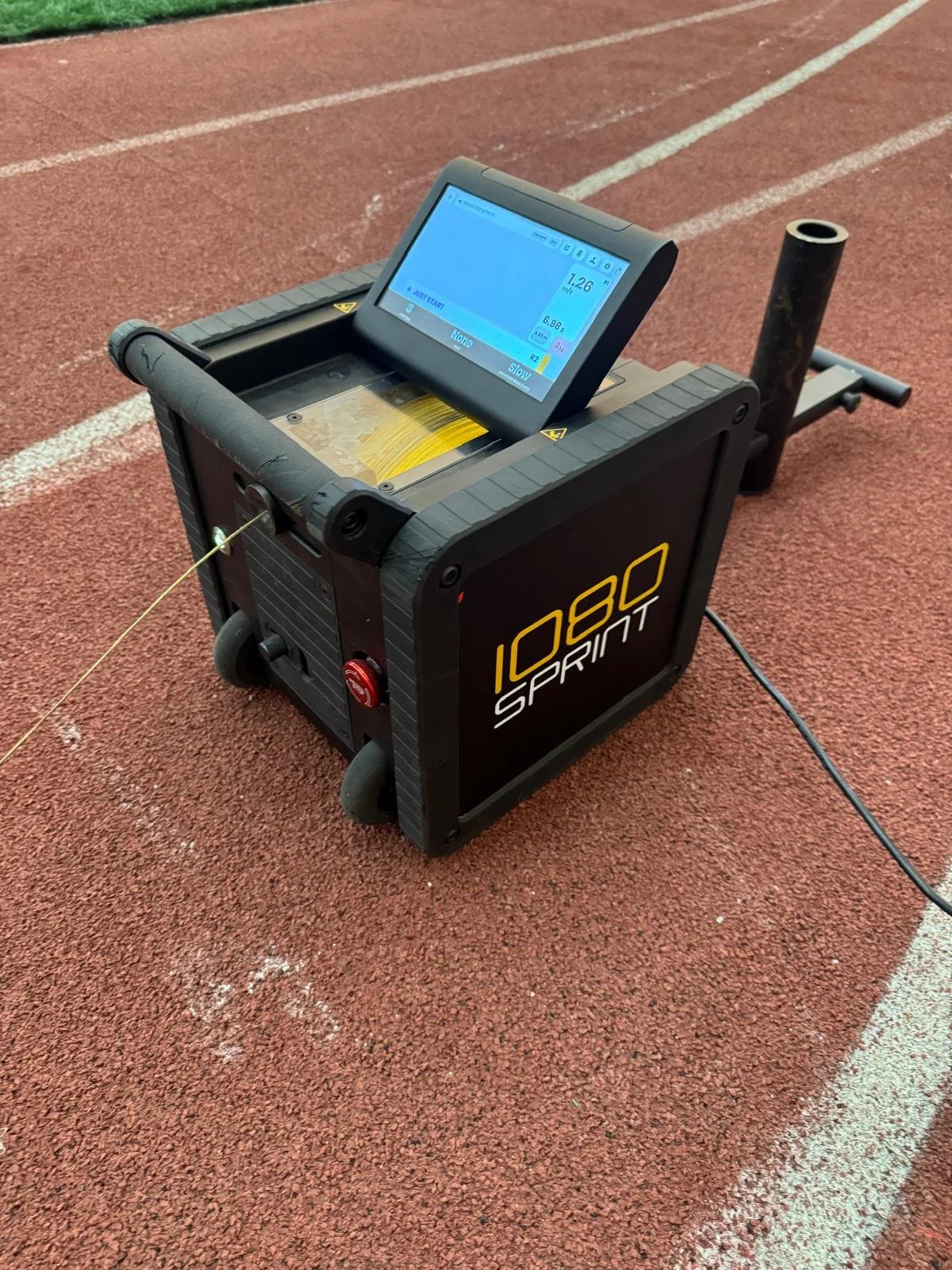
The 1080 Sprint is a robotic resistance and assistance training device we use to measure sprint force-velocity profiles and develop acceleration mechanics in our jumpers. Operating this equipment has given me a hands-on understanding of how data-driven tools translate directly into programming decisions.
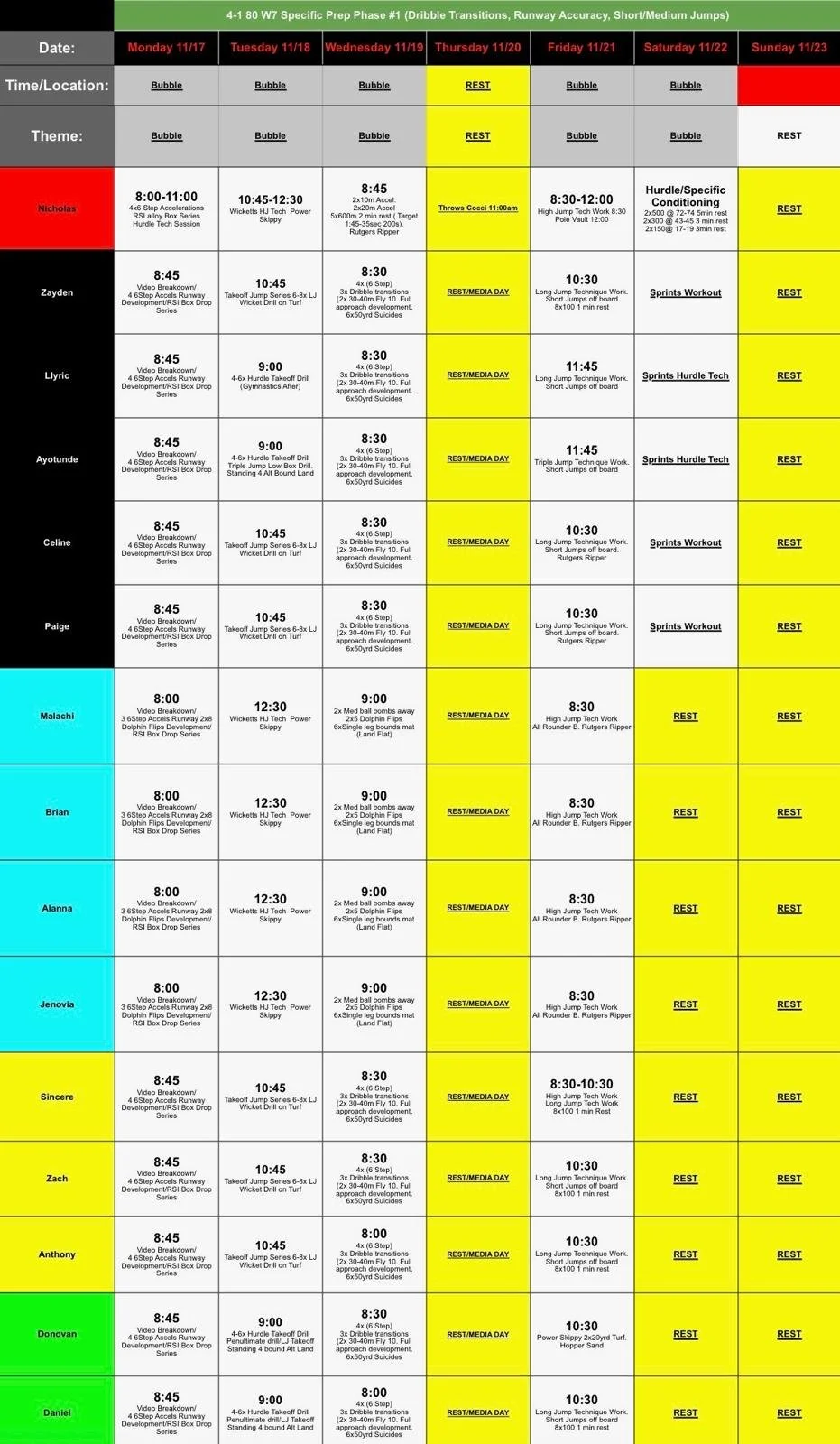
A sample weekly training plan from the jump group showing the structure of a non-meet week. Managing training load, intensity, and recovery across the competitive calendar is one of the skills I have developed through this internship.
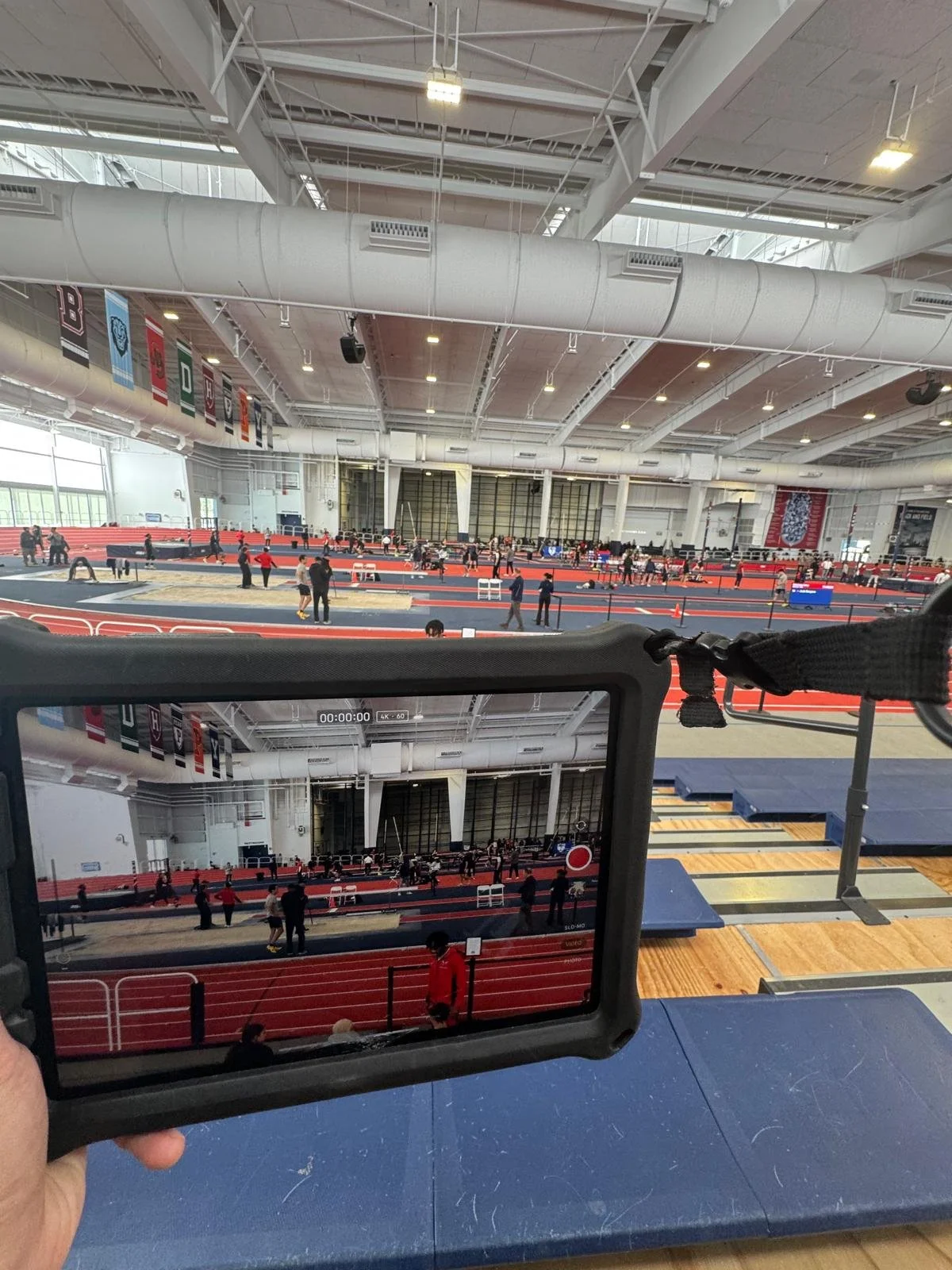
Recording technical footage during competition at UPenn. Capturing video in a live meet environment requires focus and precision, every jump is one take, and the footage collected directly informs how we approach training in the weeks that follow.
Fly-10 meter sprint testing using speed gates during a jump session at Rutgers. Timing data collected here gives coaches an objective measure of athlete speed development across the training season.
Soft Skills
Soft Skill #1: Communication
Communication is the skill that ties everything else together. It does not matter how much you know about biomechanics, periodization, or movement science if you cannot deliver that knowledge in a way that the athlete in front of you can actually use. This is something I have had to learn, and keep learning, every single day on the track at Rutgers.
I have developed the ability to translate complex technical concepts into concise, athlete-friendly cues that land in the moment without interrupting the flow of a session. I have learned that the same correction can be delivered ten different ways, and that finding the right one for the right athlete at the right moment is itself a skill that takes years to develop. This connects directly to Learned Outcome #4 of coaching technique, and it is the foundation upon which my long-term goals as a coach, PT, and facility owner will be built.
Soft Skill #2: Attention to Detail
In track and field, the details are everything. A two-degree change in hip position at takeoff can be the difference between a personal best and a scratched jump. A subtle compensation pattern in an athlete's approach run can be an early warning sign of an injury waiting to happen. Attention to detail is not just a personality trait. It is a professional necessity for me to work to sharpen every single day.
This skill has grown most directly through my video analysis work at Rutgers, where I have trained myself to observe not just the obvious but the subtle things that happen in a fraction of a second that most people would miss entirely. It reinforces Learned Outcome #1 (biomechanics) most directly, but honestly it runs through every outcome I have described in this portfolio. As I move toward any career, attention to detail will be the skill that protects my clients, earns their trust, and defines the quality of the work I produce.
Soft Skill #3: Problem Solving
No session ever goes exactly according to plan. An athlete arrives with a nagging injury. A technical cue that worked perfectly last week suddenly stops clicking. The program needs to be rebuilt on the spot because the situation has changed. Or sometimes as simple as learning a new drill or new equipment. Problem-solving is the ability to look at what is actually in front of you, identify what is really going on, and find a solution that works right now. It is a skill I rely on every single day inside the Rutgers program. This skill connects to all four of my learned outcomes because real-world coaching is fundamentally about navigating the gap between what the textbook says and what is actually happening on the track in front of you. It is the skill I am most proud of, and the one I believe will define my career long after the technical knowledge becomes second nature.